
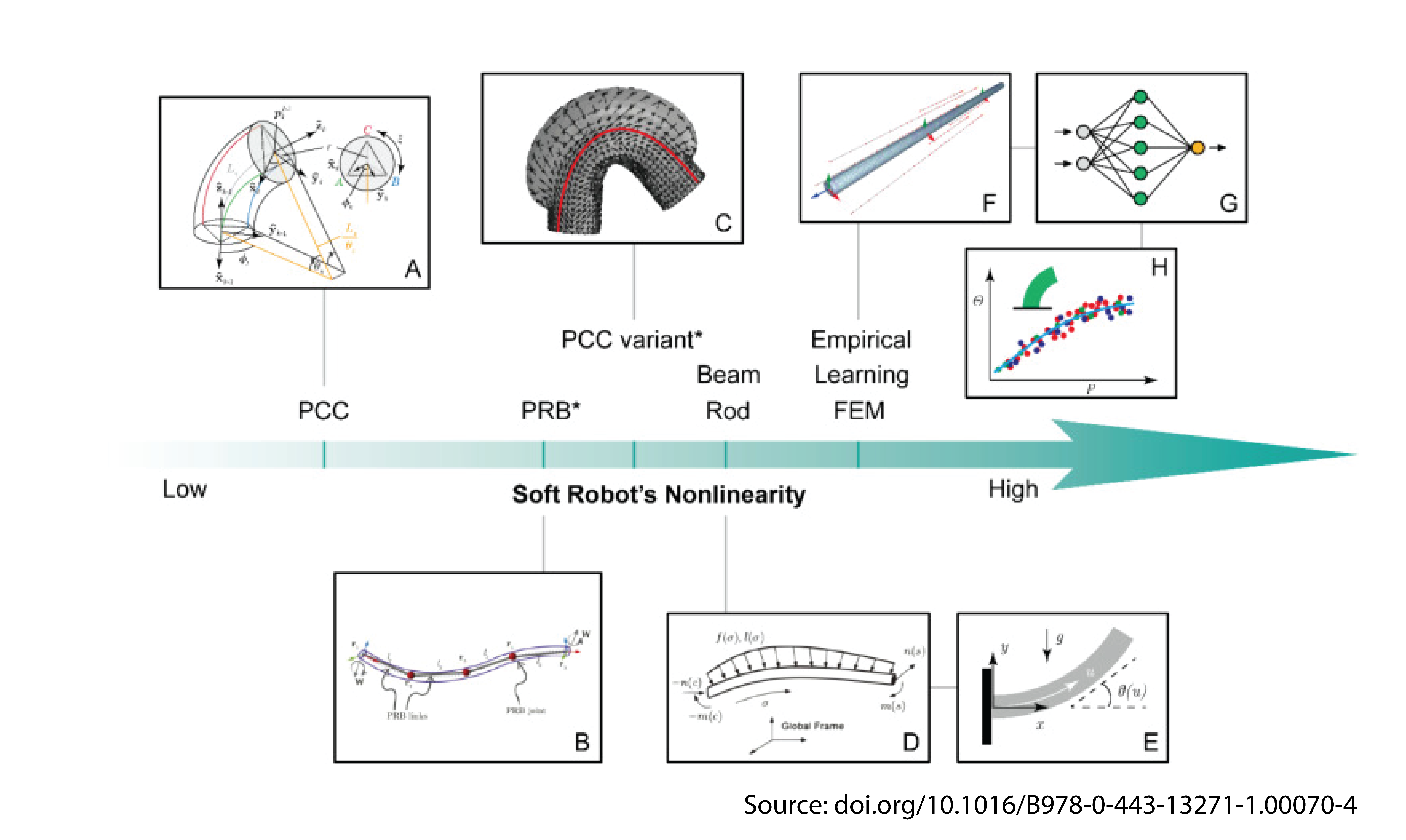
Project Overview
The Soft & Flexible Robotics project focuses on advancing compliant mechanism design and control to create soft manipulators that adapt to complex environments and perform delicate tasks with safety, precision, and dexterity. This research addresses the growing need for robots that can safely interact with humans and handle fragile objects.
Goals
- Safe Human-Robot Interaction: Develop manipulators that can work safely alongside humans
- Adaptive Grasping: Create grippers that can handle objects of various shapes and fragilities
- Compliant Control: Design control systems that leverage mechanical compliance for better performance
- Versatile Applications: Enable robots to perform diverse manipulation tasks in unstructured environments
Key Research Areas
- Compliant Mechanism Design: Engineering structures that provide desired flexibility and compliance
- Soft Actuation: Development of actuators that provide smooth, safe motion
- Motion-Primitive Navigation: Primitive-based planning and control for compliant and vibration-driven robots
- Adaptive Control: Control algorithms that work with compliant mechanical systems
- Sensing Integration: Incorporating tactile and force sensing for intelligent manipulation
Team Members
Principal Investigator
- Dr. Chien Truong-Quoc - Hanoi University of Science and Technology (HUST)
Undergraduate Students
- Mr. Giap Nguyen Trong - Hanoi University of Science and Technology (HUST)
Current Research Focus
- Material Innovation: Exploring new soft materials for robotic applications
- Mechanical Design: Creating novel compliant joint and linkage systems
- Control Strategies: Developing algorithms that exploit mechanical compliance
- Performance Optimization: Balancing safety, precision, and speed in manipulation tasks
Applications
- Healthcare: Assistive devices and rehabilitation robotics
- Manufacturing: Handling delicate components and materials
- Service Robotics: Domestic and personal assistance robots
- Research Tools: Laboratory automation and scientific instrumentation
Key Features
- Inherent Safety: Mechanical compliance provides natural safety in human interaction
- Adaptability: Ability to conform to irregular shapes and surfaces
- Precision: Fine manipulation capabilities for delicate tasks
- Robustness: Resilience to impacts and unexpected contact
Future Directions
- Integration of advanced sensing and AI for intelligent manipulation
- Development of self-healing and self-repairing soft materials
- Scaling up for industrial applications
- Miniaturization for micro-manipulation tasks
Publications
- Vuong-Duc, M., Nguyen, T. G., Nguyen-Thai, M.-T., & Truong-Quoc, C. (2026). Motion-Primitive Navigation of a Flix-Walker Under Payload and Friction Variations. Robotics and Mechatronics, Proceedings of ISRM 2026, Mechanisms and Machine Science, vol. 213, 220-228. DOI: 10.1007/978-3-032-29469-2_23
- Trong, G. N., Truong-Quoc, C., & Nguyen Quang, H. (2025). High-Fidelity Modeling of the Flexible Inverted Pendulum via Pseudo-Rigid-Body (PRB). Proceedings of the 8th International Conference on Engineering Mechanics and Automation (ICEMA 2025), Hanoi, November 14-15, 2025. DOI: 10.15625/vap.2026.0008
Funding
- Mô hình hóa và điều khiển các cơ cấu, robot liên tục dựa trên trí tuệ nhân tạo - Supported by Hanoi University of Science and Technology (2026-2027).
🔍 Search for Soft & Flexible Robotics related papers on the Research page