
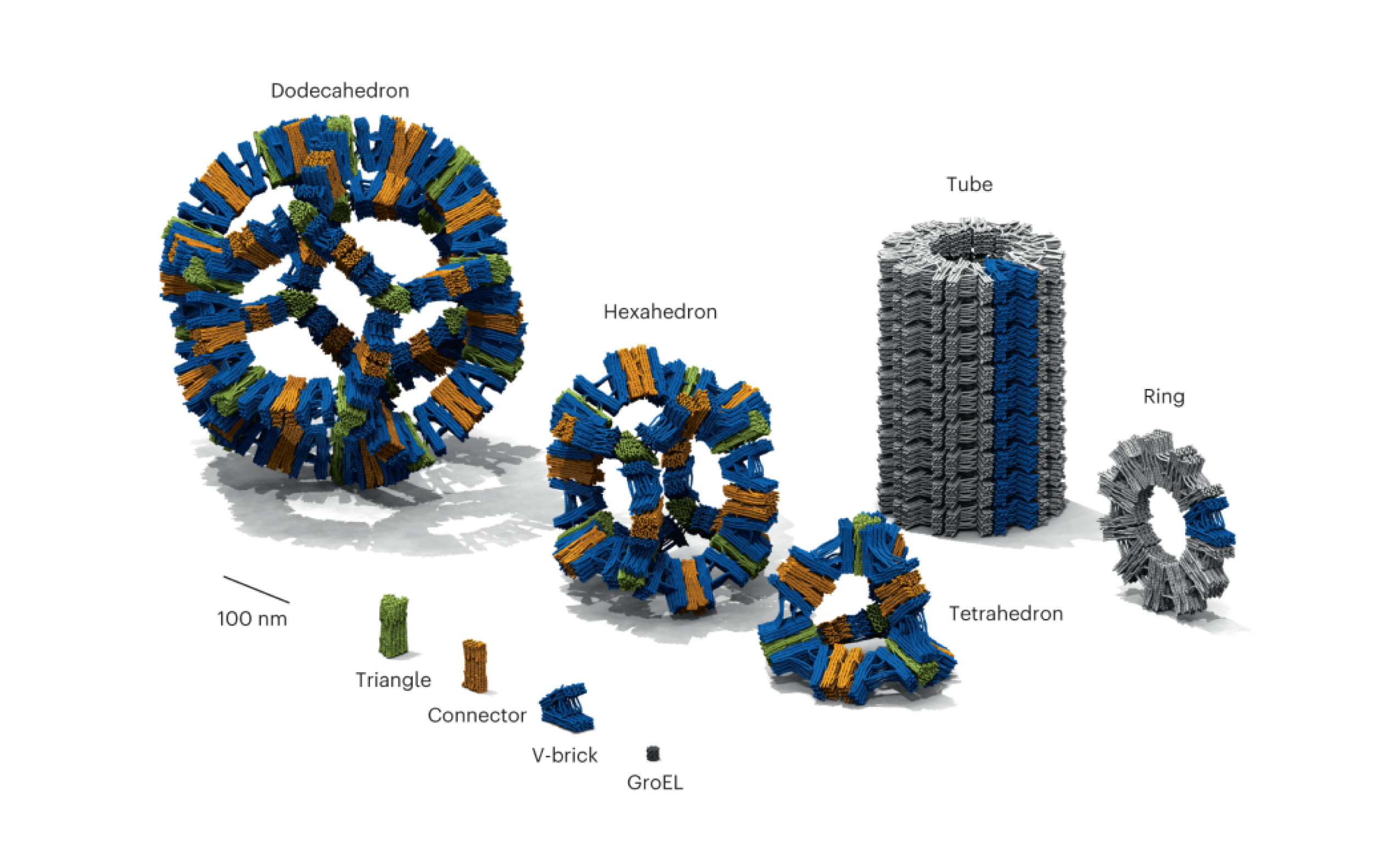
Project Overview
DNA origami nanotechnology enables programmable molecular structures whose geometry and function can be designed from DNA sequence-level information. This project develops computational and AI-driven methods for DNA origami shape prediction, inverse design, and de novo generation of nanoscale architectures.
The work builds from DeepSNUPI, a graph neural network framework for DNA origami shape prediction, toward broader generative design pipelines that connect target geometry, strand routing, structural simulation, and experimental validation.
Goals
- Predictive Modeling: Develop machine learning models that reliably predict the 3D equilibrium shapes of DNA origami designs
- Generative Design: Create AI frameworks that propose physically plausible DNA origami structures from user-defined target geometries
- Rational Design Tools: Integrate simulation, strand routing, and quantitative evaluation into practical design workflows
- Experimental Validation: Bridge computational predictions with folding experiments, microscopy, and functional tests
- Programmable Function: Explore reconfigurable, modular, and mechanically responsive DNA nanostructures
Key Research Areas
- Shape Prediction: Graph neural network models for fast and accurate DNA origami structure prediction
- Inverse and De Novo Design: Generative diffusion models for proposing new DNA origami architectures from target shapes
- Multiscale Simulation: Physics-based computational models for equilibrium structure generation and validation
- Strand Routing and Design Automation: Algorithms that convert geometric concepts into realizable DNA origami designs
- Functional Nanostructures: Auxetic transformation, modular assembly, and reconfigurable nanoscale systems
Key Achievements
- Published a generative DNA origami design framework in Nature Communications (2026)
- Published DeepSNUPI, a graph neural network approach for DNA origami shape prediction, in Nature Materials (2024)
- Developed AI models for both forward prediction and inverse design of complex DNA nanostructures
- Experimentally validated selected generated DNA origami structures and functional behaviors
- Created computational workflows for expanding the accessible design space of DNA origami nanotechnology
Team Members
Principal Investigator
- Prof. Do-Nyun Kim - Seoul National University
Collaborators
- Dr. Chien Truong-Quoc - Co-Lead, AI and computational design
- Dr. Chanseok Lee - Co-Lead, experimental validation and DNA nanotechnology
- Dr. Kyounghwa Jeon - Co-Lead, generative design and experimental validation
- Dr. Jae Young Lee - Co-Lead, DeepSNUPI algorithm development
- Dr. Kyung Soo Kim - DeepSNUPI experimental validation
Students
- Graduate students and undergraduate researchers contributing to computational modeling, generative design, and experimental validation
Publications
- Truong-Quoc, C., Jeon, K., Kim, J. et al. “De novo design of DNA origami with a generative diffusion model.” Nature Communications (2026). DOI: 10.1038/s41467-026-73578-z
- Truong-Quoc, C., Lee, J.Y., Kim, K.S., Kim, D.N. “Prediction of DNA origami shape using graph neural network.” Nature Materials (2024). DOI: 10.1038/s41563-024-01846-8
Patents
- Kim, D.N., Truong-Quoc, C., Lee, J.Y. “Device and method for predicting DNA origami structure.” U.S. Patent Application No. 20250246267 (2025). Patent Link
- Kim, D.N., Lee, C., Truong-Quoc, C., Jeon, K. Patent application covering a generative diffusion model framework for DNA nanostructure design. Korean Patent Application No. 10-2026-0067822 (pending).
Future Directions
- Generative design of increasingly complex and reconfigurable DNA origami architectures
- Integration of target geometry, strand routing, simulation, and experimental feedback in a unified workflow
- Development of fast, interactive design tools for the DNA nanotechnology community
- Applications in molecular robotics, biosensing, drug delivery, and programmable materials
🔍 Search for DNA Origami Nanotechnology related papers on the Research page